


7 Signs Your Hair Extensions Have Been Fitted Badly
If your extensions are visible, painful to sleep on, slipping out early or leaving your own hair thinner at every removal, the fitting is the problem and not your hair. Badly fitted extensions show seven clear signs. At AV Extension in London we see all seven regularly, usually on clients who were told the fault was theirs.
Key takeaways
Bonds that you can see in a mirror have been placed against the direction of your hair growth, or they are simply too large for your hair.
Pain, itching or difficulty sleeping is not something you get used to. It means the bonds are sitting too close to the scalp or carrying too much weight.
Bonds slipping within the first weeks is a fitting problem, not an aftercare problem, if you have followed the instructions you were given.
A flat, single colour that sits on top of your own hair means the hair was not blended from more than one tone.
If your ponytail is visibly thinner at every removal, the weight and the bond size were wrong for your hair.
Being told the problem is your hair type or your washing routine is the eighth sign, and it is the one that costs women the most.
Why do badly fitted extensions damage your own hair?
The damage comes from tension, not from extensions as a category. Every bond carries the weight of the added hair, and that weight pulls on a small number of your own strands at the root.
A bond weighing around 1 gram, which is the common industry size, anchors that weight to a small section of hair. Our invisible keratin bonds weigh 0.2 grams. The same volume of hair is therefore spread across roughly five times as many anchor points, so no single section carries much.
That is the whole mechanism. Weight divided by attachment points. When one salon says extensions ruined a client's hair and another says extensions grew it, they are usually describing this difference and not two different products.
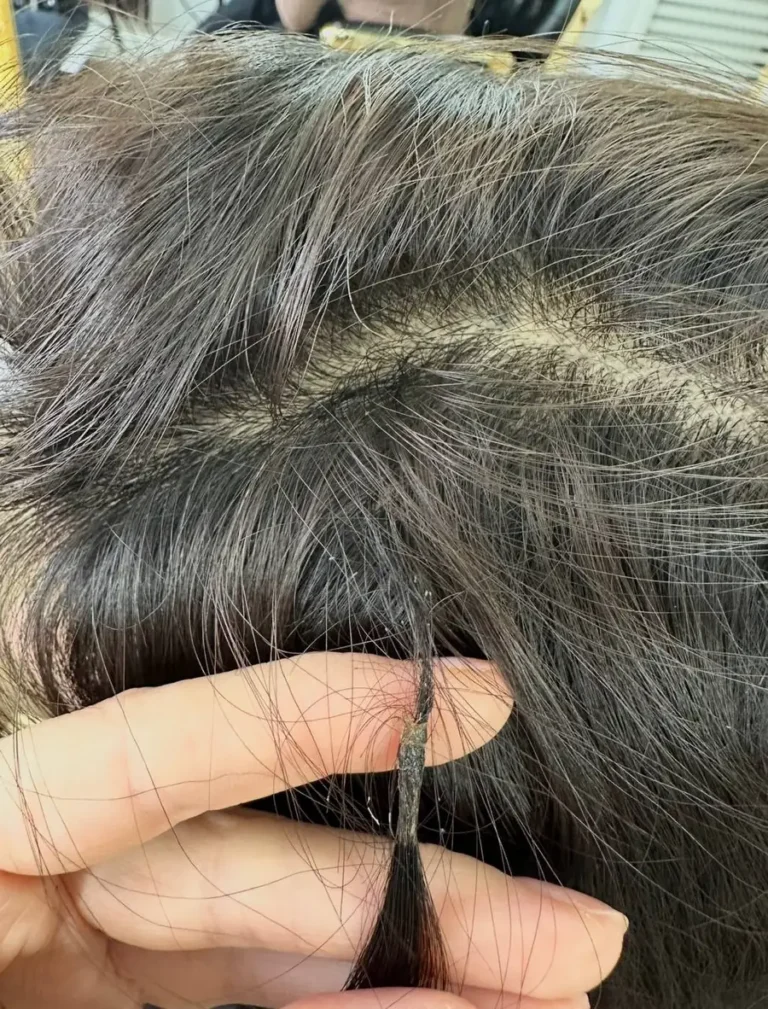

Sign 1, can you see the bonds in the mirror?
Stand in front of a mirror in daylight, lift the top layer of your hair and look at the row underneath. You should have to hunt for the attachment points.

Size is only half of it. The other half is placement. Bonds have to follow the direction your hair falls, and they have to sit under a layer that covers them. A small bond placed against the growth direction is more visible than a larger bond placed correctly.
Our founder, Ariadna, spent about three months practising placement on a mannequin head before she was satisfied. What she found was that the tool decides the size, pliers of around 2 mm being what forms a bond that small, and that the placement decides whether anyone can see it. Both have to be right.
Sign 2, can you sleep comfortably on them?
You should be able to lie on your back and feel nothing.
If you feel pressure points, if you shift position to get comfortable, or if you wake up with a sore scalp, the bonds are sitting too close to the root or they are too heavy for the hair holding them.
Ariadna wore nano rings herself before she trained. The metal rings pressed on her scalp every night, she could not tie her hair up, and they were visible. That experience is the reason this studio does not fit them.
Sign 3, does your scalp itch or feel pulled?
Itching at the roots is usually tension. So is a dull ache when you tie your hair back, or the feeling that something tugs when you brush.
Some tenderness in the first day or two after a full fitting is normal, because your scalp is adjusting to weight it has not carried before. Tenderness that is still there in week three is not.
Sign 4, are bonds slipping out in the first weeks?
Losing a small number of bonds over a full wear period is normal. Losing them in the first weeks is not, provided you have followed the aftercare you were given.
Slipping usually means the bond was not sealed properly, the hair section taken was too small for the weight, or the wrong products reached the attachment point. We cover a failed bond for 2 months on the fitting itself, and we guarantee the hair we supply for 12 months when it is cared for as instructed.
If you are losing bonds and being told to buy a different shampoo, ask how many bonds were fitted and how much hair each one is carrying.
Sign 5, does the colour sit on top instead of blending?
Your own hair is not one colour. It has depth at the root, lighter pieces through the mid lengths, and it changes across the head.
Extension hair supplied as a single flat tone will always read as separate, however well it is fitted. It looks like hair placed on hair.
We keep over 300 tones in stock and mix physically in the studio under three light sources, because a match that works under a salon lamp can fail in daylight. Most matches use more than one tone. One recent client needed three tones blended together, because her previous set had been a single colour and the line where it started was obvious. You can see how this reads in daylight across our client work.
Sign 6, is your hair thinner at every removal?
This is the sign that matters most, and it is the one clients notice too late.
Take a photograph of your ponytail before your extensions go in, and take one immediately after every removal, before anything else is fitted. Same light, same position. Compare them.
Shedding of some hair at removal is normal, because hair you would have lost naturally over the wear period has been held in place by the bond and comes away at once. A ponytail that is visibly narrower each time is not normal.
Sign 7, were you told it was your fault?
Before she trained, Ariadna went back to the technician who had fitted her nano rings and showed her how much hair had come out. She was told the problem was that her hair was light and thin, and that she had not cared for it properly.
She had cared for it properly. She had used the products she was told to use.
Because she did not know any better, and because the price was affordable, she had the same fitting done a second time. The second removal left her with almost nothing. That is the reason she trained, and it is the reason this article exists.
A technician who cannot explain what went wrong in terms of bond size, weight and placement is a technician who does not know. Being blamed for your own hair is the clearest sign of all.
What should you do if you recognise these signs?
Do not remove keratin bonds at home. Pulling or cracking them without the right solution breaks hair mid shaft and pulls it from the root, particularly if your hair is fine, bleached or already shedding.
Book a removal and correction with someone who will look at your own hair before selling you the next set. A proper assessment covers what came out, what is left, whether anything should go in at all right now, and what a realistic plan looks like.
Sometimes the honest answer is to wait. We have told clients to leave their hair alone for a period before we fit anything, and we would rather say that than take the booking.
Frequently asked questions
Can badly fitted extensions cause permanent hair loss?
Prolonged tension at the follicle can cause traction alopecia, and in advanced cases regrowth is not guaranteed. Caught early, hair usually recovers once the tension is removed. If you are seeing bare patches or a receding hairline, see a GP or a trichologist before booking any extensions.
How soon should I have them taken out if something feels wrong?
Sooner rather than later. Tension damage accumulates. A removal costs far less than a year of regrowth.
Will I have to shave my head or cut my hair short?
Almost never. Most of the correction work we do involves removing what is there, assessing what remains, and refitting with smaller bonds so the hair can recover while still looking full.
Can extensions be fitted again on hair that has already been damaged?
Often yes, with lighter bonds and fewer of them, provided there is no active shedding. We can work on natural hair from 5 cm. This is assessed at consultation and it is not a decision to make from a photograph.
How much does a consultation cost?
It is 50 pounds for 45 minutes in the studio, it includes a five bond test so you can see and feel the size, and it is deducted from the cost of a full fitting. You can book a consultation whenever you are ready.